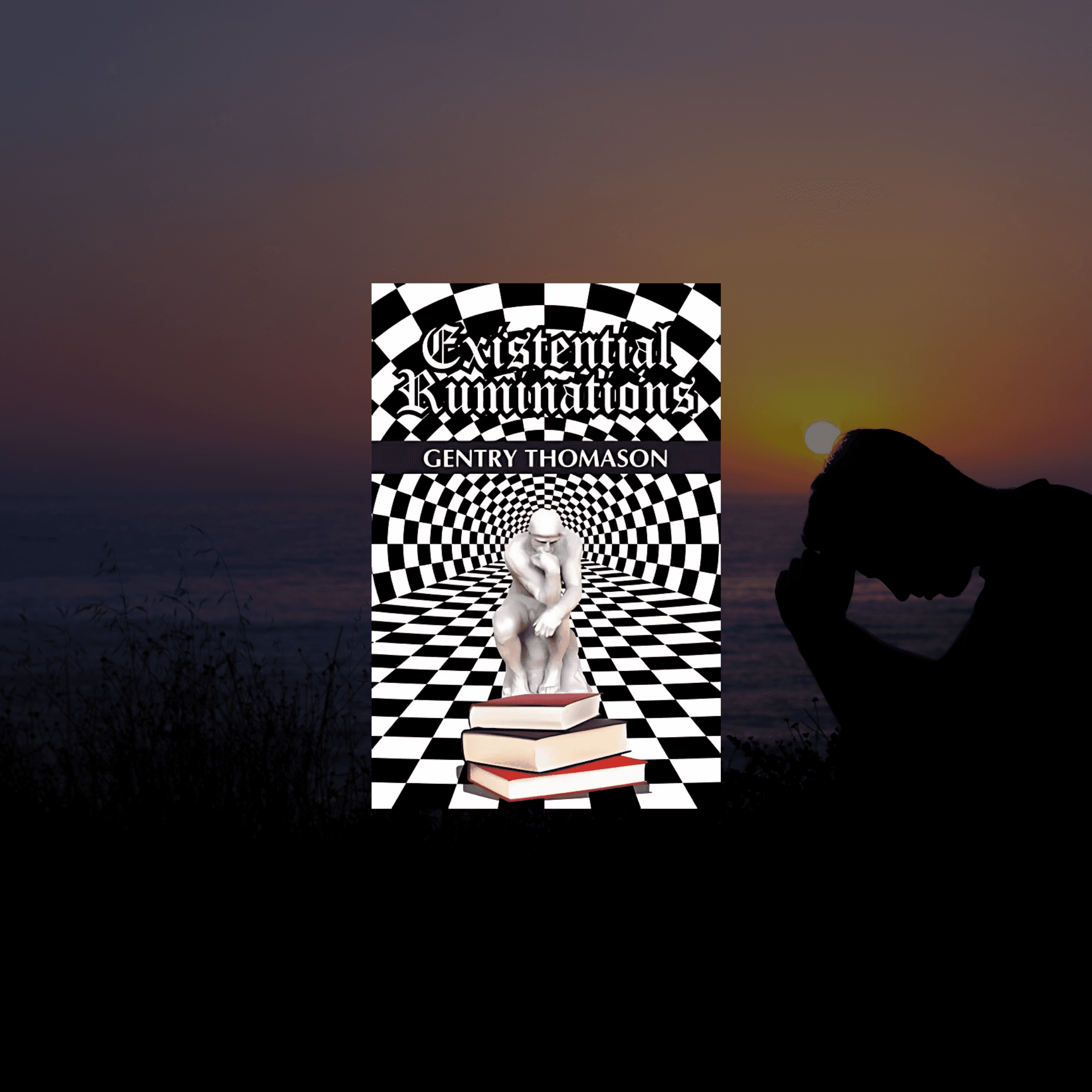
Existential Ruminations (ER) has been described as a “feast” for thinking persons. The book contains 198 prose poems (poemographs) that offer original thoughts on human existence and human aspirations for life beyond death. It’s Introduction presents a background miracle experience that influences all following reflections. Five major sections discuss Existence and Eternity, Truth and Reality, God, Religion and the Supernatural, Self and Others, and Character, Love and Vision. The book’s essential core is Philosophy, Psychology and Religion. The breadth of ER is specific and expansive, and invites the reader to give serious thought to his/her personal take on every proffered idea. Human life is seen as a fragile sliver operating in an immense multi-universe that knows no boundary. Some of the author’s personal experiences are presented and exemplifed further in an Addenda (a short story, “Richmond Pass,” that was a minor miracle experience, and a series of car crash photos that illustrate his uncanny survival in that crash). It is suggested throughout that the Holy Spirit may have been at work in those experiential moments. Two poemographs advance the existential/philosophical idea: “Existence (precedes Essence)” in the Preface and “Essence (supersedes Existence)” in the book’s Postscript. Human essence is a central theme.
Chapter Outlines
Preface
The Preface offers reflections on human existence and contrasts the immense insignificance of a human life in a boundless multi-universe with the existential sound sense necessary for communal coherence. Human experience is identified as existential, and Jean-Paul Sartre’s nugget that that “existence precedes essence” is given reflection.
Introduction
The Introduction briefly discusses the style and fashion of the author’s penmanship and states that “What [is articulated] in this volume is something like a summation of what life’s been about ... and what most of us sense and grasp as we advance in age and maturity.” One poem present a miracle experience (with photos) while another presents a quasi-miracle experience that occurred during the author’s younger years. His reading background (six plus decades) and the authors he adopted as mentors are then critically reviewed, and his lived reality as a “Man (in the Wilderness)” is noted. His youthful atheism is discussed in light of the recognition that there is a Supernatural Being at work in human existence and human reality.
Section One: Existence and Eternity
Section One of ER works in a staccato rhythm between thoughts of existence and reflections on a possible reality in eternity. The reality of death is given prominence as is the vulnerability of being human in today’s world and in history. Life is viewed as a gift that is without precedence prior to birth. Questions are raised about what human beings would be like in eternity and how differences between people (viewpoints and attitudes) might be handled or tolerated by divinity. Knowledge of life in eternity is acknowledged as speculative and grounded in vast ignorance. Human roguishness is recognized as a limitation on admittance to a heavenly realm; knowledge of heaven itself is respected as an “undiscovered country”. The possible need for souls to be reformed or “swept clean” for admission into eternal life is documented, and human shortcomings are identified for reflection. The reality of death is given appreciation as sorrowful, and eternal nada or nothingness is admitted to be a possibility. The hope for eternal life is underscored as most desirable.
Section Two: Truth and Reality
The issue of truth and truthfulness is taken up in Section Two of ER. Recognition is made that the search for truth is a noble and arduous undertaking that many fail to assume. Achieving honesty (truthfulness) is held to be a serious endeavor that requires devotion and integrity that many flounder on or never venture. Personal human belief system(s) are described as socially and culturally acquired; challenging one’s belief system(s) requires ambition and rigorous intellectual questioning. One’s view of reality is recognized as a function of many forces and influences. Admission is made that all human beings are cosmically parochial and encompassed in a staggering ignorance—a natural condition. Schooling one’s mind, heart and personal passions is urged if one is to achieve sincerity of purpose. The quest for self-definition demands an exploration of one’s concrete experiences, proclivities and psychological fixations. Examining evidence and avoiding easy believing is encouraged. Human faultiness is exposed; thinking critically is offered as a deterrent to conditioned responsiveness.
Section Three: God, Religion and the Supernatural
The issue of knowing God and God’s reality is taken up in this section. Knowing God and knowing about God are suggested to be significantly different. Thoughts about God can be found in scriptures, and articulations about God may inspire belief: All such propositions, however, require careful evaluation to avoid blind belief and adoption. The statement that “God is love” is found to be questionable: Personal and cultural experiences radically suggest otherwise. Happy propositions are challenged as sophomoric. Over a dozen poemographs question a mindless adherence to simple beliefs in God. God’s allowance of evils suggest responsibility as well as God’s absenteeism and choosing to do nothing in the face of such evils. Religious beliefs are found to be at odds with the search for truth; one’s upright, honorable conscience is regarded as a decisive counter to unexplored, conditioned beliefs and behaviors. Mankind is seen to be engulfed in impenetrable mysteries, yet dismissing God is found to be problematic and likely erroneous (based on the author’s own experience as discussed in the Introduction). The possibility of eternal life is seen to be a divine gift that would also be dumbfounding. Positive views of divinity are offered along with the thought that God’s high holiness may need to be refigured. Ultimately, there seems to be no compellingly good answer to the negatives that human beings suffer.
Section Four: Self and Others
This section reviews the author’s miracle experience on Genesee Avenue in San Diego in August of 1979. Mankind’s belief in original innocence is exposed to what happens when humans grow up and discover otherwise. Deep imperfections are found to characterize human beings and human nature. The author’s miracle experience is seen to shake him out of his twenty year long atheism; his existential stress experiences are recognized as admonishment warnings. Human foibles and inclinations are described; factors in and of unsound relationships are detailed. The Holy Spirit, God the Third Person, is identified as a possible source for the author’s extreme stress ordeals (previously thought to be a demonic affliction phenomenon). Poemographs discuss the author becoming his own “inner therapist” along with problematic relations with others. Human shortcomings are described; the presence of supernatural influences at work in human endeavors is articulated. Music is seen to be a refuge in life.
Section Five: Character, Love and Vision
This section begins with what the bottom line should be for one’s eternal salvation: Humane good character. Character counseling is regarded as essential for achieving a positive eternal destiny. Responsibility, loving kindness and mature self-criticizing are important factors in character formation. The cultivation of sound character can help one to acquire an “enduring North Star.” Several qualities of good character are identified; love is valued as a bottom line that “holds all together.” Various similar virtues are identified and valued. Positive and negative traits are discussed and scrutinized. Extended vision and higher honesty are recommended. Finally, newer vision is profiled and urged for the task of achieving a mature foundation of Self: One “who dares to question his verities and certainties / becomes a pioneer in the forest of doubt / where convictions break down and flounder about / until newer vision makes for peace and redoubt. / [Such] is accomplished through earnest effort?” Questions like this are asked throughout the five core sections of Existential Ruminations.
Postscript
Speaking truth to power, asking uncomfortable questions and reflecting on one’s existential composition are poised in this section. One’s genetic inheritance is found to be a controlling factor in one’s ascent to a higher lived reality, and is reasoned to be a functional reality given by God (?). The question is raised that an ultimate eternal reality may be misidentified as “heavenly bliss,” that such imagining may be false. Lastly, reflection is made on human essence that “supersedes existence.”
Another Brief Section
This section includes some of the author’s favorite music selections and films.
Addenda
A short story, “Richmond Pass,” is presented that exposes the author’s sense of a minor miracle that occurred to him as a high school senior football player. Additionally, a brief discussion is given of an auto accident (with photos) the author survived in his 24th year following graduation from Officer Candidate School and his commissioning as an Army Second Lieutenant. His survival of that accident is itself explained as an uncanny miracle.
Further Thoughts and Considerations
This final section of Existential Ruminations recaps and reviews the epos of the book’s thoughts and proffering. A description and summary of ER’s major miracle experience is recounted to give a more precise rendering of that event, and is given a finer definition as an “instantaneous relocation” experience with “philosophical implications.” The author’s sense of the miraculous is recounted in “Striking Phenomenal Parallelisms.” A critical review is next with the author’s reply. Daniel P. Cronin’s prose poem, “What is Dying?” is given and followed by the poemographs “Compassionate (Caring)” and “Life (and Eternity).” The author’s brief biography concludes the textual script and is followed by an Index and a picture of a ship in stormy weather—a metaphor for the author.